Build, buy, or compose: owning your ordering stack without building everything
Brands feel stuck between rented ordering templates and costly custom builds. Composing the stack lets you own what differentiates you, buy what does not, and keep every choice reversible.
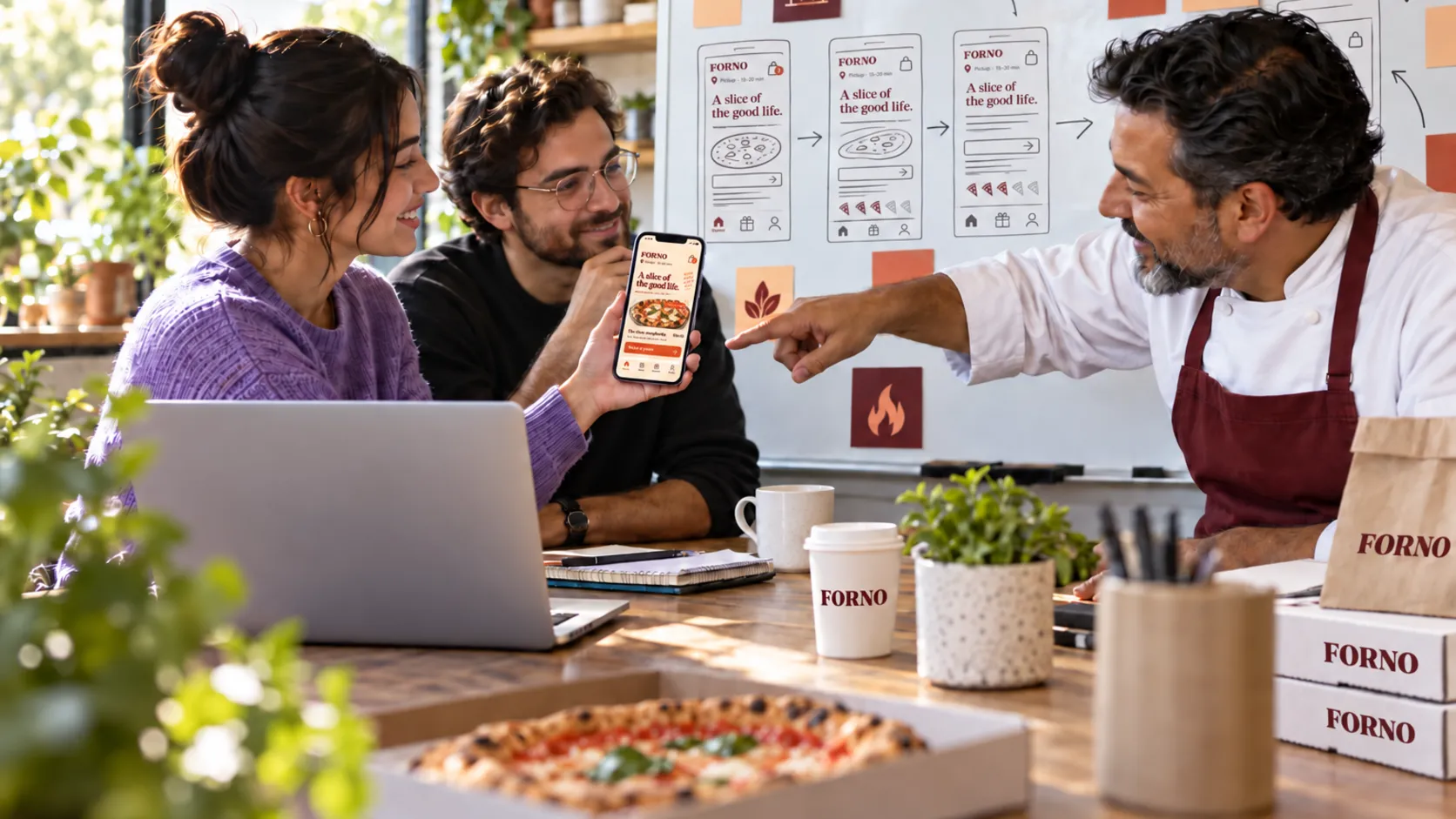
Most restaurant brands reach the same fork once digital ordering matures. One path is an off-the-shelf ordering template: fast to launch, reasonably reliable, and nearly identical to every other brand using it. The other is a fully custom build: owned and distinctive, but slow, with a maintenance bill that never stops arriving.
Leaders tend to frame this as a binary. Rent the experience, or build the whole thing. Both options carry costs that show up later, and both miss the point. A restaurant ordering stack is not one thing. It is a set of layers, and each layer deserves its own decision.
The false binary
The template path trades control for speed. You get a working storefront quickly, but your roadmap belongs to the vendor. The experience looks like your competitors'. Guest data may sit in a system you access rather than own. And when you want something the template does not support, the answer is a feature request.
The custom path trades speed for control. You own the code and the experience, but you also own payments compliance, POS quirks, delivery dispatch logic, uptime at dinner peak, and every upstream API change. The risk is that most of your engineering capacity ends up keeping commodity parts running instead of improving what guests actually see.
Neither outcome is a failure of execution. It is a failure of scope. The decision was made for the whole stack when it should have been made layer by layer.
What composing means
Composing means owning the layers that make your brand different, buying the layers that are the same for everyone, and connecting them through an integration layer you control.
For most multi-location brands, the split looks something like this:
 Own
OwnThe brand experience guests see, the guest data and relationship, and the menu model every channel depends on.
 Buy
BuyPayments, POS, delivery dispatch, and other capabilities where specialists have already solved the hard, regulated, or heavy problems.
 Connect
A shared domain model for menus, carts, orders, and guests, with an adapter per provider, so bought layers can change without rewriting owned ones.
The integration layer is what makes composing work. Without it, buying a POS or loyalty provider quietly means wiring your owned layers directly to that vendor, and you are back to lock-in. We cover the patterns that keep that layer healthy in the integration tax.
Own what makes guests choose you. Buy what guests never notice. Control the seams between them.
A decision framework
For each layer, work through five questions.
Differentiation. Would a guest notice if this were the same as a competitor's? The ordering flow, menu presentation, and how loyalty feels are usually yes. Card processing and ticket routing to the kitchen are usually no.
Rate of change. How often does this layer need to change for business reasons? Layers that move with every campaign, launch, or menu cycle reward ownership. Stable layers reward buying.
Talent. Do you have, or can you reliably access, people who can build and run this layer well? Owning a layer you cannot staff is a liability, not an asset.
Total cost of ownership over time. Compare cost across several years, not at launch. For bought layers, include fees that scale with volume and the cost of working around limitations. For built layers, include maintenance, on-call, security, and upgrades.
Exit costs. What does it cost to leave? Look at data export, contract terms, and how deeply the vendor's model has spread into your other systems. A cheap entry with an expensive exit is not cheap.
A simple view helps structure the conversation:
| Layer | Differentiation | Rate of change | Typical call |
|---|---|---|---|
| Brand experience and ordering UX | High | High | Own |
| Guest data and relationship | High | Medium | Own |
| Menu model | High | High | Own |
| Loyalty engine | Medium | Medium | Case by case |
| POS | Low | Low | Buy |
| Payments | Low | Low | Buy |
| Delivery dispatch | Low | Medium | Buy |
Your answers may differ. A brand whose identity rests on a distinctive loyalty program might own more of that layer. The point is to decide on purpose, and to write down why.
How AI-assisted engineering changes the build math
AI-assisted engineering has changed the cost of building. Generating components, writing tests, migrating code, and iterating on UI are all meaningfully faster than they used to be. For the layers you choose to own, that shifts the balance. Iteration that once took a sprint can often happen in days, which makes owning the brand experience realistic for more brands.
It does not change everything. AI makes writing code cheaper. It does not make owning code free. Every line still has to be understood, reviewed, secured, and maintained. Architecture decisions, such as where the domain model lives, how failures are contained, and what belongs in an adapter versus the core, still need experienced people making deliberate choices. Faster code generation without sound architecture just produces a bigger system to maintain.
The practical conclusion: use AI to widen what you can own, not to justify rebuilding commodity layers yourself. Let AI speed up the brand experience and the menu tooling. Keep buying payments.
Governance: who owns the roadmap
Composing a stack also means composing a team. Someone has to own each layer, and someone has to own how the layers fit together.
A few habits make the difference:
- One owner for the domain model. Menu, order, and guest definitions need a single accountable owner, usually in technology, with real input from operations and marketing.
- A roadmap you write. Every vendor has its own. Yours decides which of their features matter to you and when.
- Vendor reviews on a cadence. Review each bought layer against the framework at least once a year. Rate of change and cost both shift.
- An exit plan for every vendor. Not because you expect to leave, but because knowing how shapes every integration decision you make.
If the menu is one of your owned layers, start there. It feeds every channel, and modeling it as data pays off across the whole stack.
A practical way to decide
This exercise takes a few working sessions, not a long consulting engagement:
The takeaway
The real choice is not template or custom. It is which layers to own, which to buy, and how to connect them so each decision stays reversible. Own the experience, the guest relationship, and the menu. Buy the commodity layers. Control the seams. Use AI to make owning faster, and keep architecture in experienced hands.
That is the thinking behind Techtris Engine, with AI on the engineering and people on the architecture, and the Techtris API, one interface across the providers you buy. To see how they fit your stack, book a demo and we will walk through your layers with you.